
Introduction
This paper explores the accounting history of a family-owned Irish brewing business, Macardle Moore and Company (hereafter ‘Macardles’). The study is exploratory as there are no prior accounting history studies of Macardles. It is positioned as ‘traditional’ accounting history, in that it seeks to provide an economic narrative, rather than interpreting accounting in a societal or political context through a theoretical lens (Funnell, 1996). The study draws on available accounting and other records from the late 19th and early 20th centuries. This period spans a time when Macardles changed from a partnership to a limited company; and when there was a change of senior figures in the business, though still drawn from the Macardle and Moore families. This was thus a period of both change and continuity in terms of ownership and management of the business. Archival records have been used as the main source, and gaps in the records are appropriately acknowledged. Echoing the comment by Kristandl and Quinn (2018, p. 207) on the importance of brewing in human history, and their observation that archival records of breweries are “a very fruitful source for historical studies on the development of internal/management accounting practices”, this paper aims to examine the external/financial accounting practices of Macardles, i.e., as far as that can be ascertained by examining the available accounts for years and half-years, and directors’ reports.
This business was chosen as the subject for this study for two reasons. First, Macardles is categorised by Barry (2023, p. 37) as among “the notable manufacturing firms in operation in the Irish Free State at independence”; the business had been in existence in various forms since at least 1859 and located in the third-largest base for brewing in Ireland, namely Dundalk in county Louth (Callan Macardle & Callan, 1902). During this period, Macardles was at the forefront of wider development in business and brewing, including: scientific advances (Callan Macardle & Callan, 1902), commercial relationships with the British military and related export markets at a time of renewed focus on the political and military campaign for Irish independence (Callan Macardle & Callan, 1902; Gibney, 2018a); and reflecting the broader trend of conversion to a limited liability company (Gibney, 2018a).
Secondly, although histories have been published of other Irish breweries, such as Guinness (Dennison & MacDonagh, 1998; Lynch & Vaizey, 1960), Murphy’s (Ó Drisceoil & Ó Drisceoil, 1997) and Beamish & Crawford (Ó Drisceoil & Ó Drisceoil, 2015), Macardles has not been the subject of a detailed historical study. Certain aspects of the business have been examined, such as the effect of British government plans to acquire the liquor industry during World War I (Gibney, 2018a), and the role played by Macardle family members in civic society (Gibney, 2018b). Ownership was shared between members of the Macardle and Moore families, who were cousins. The significant wealth of the owners, particularly the Macardles, as measured by the value of their estates at time of death, indicates the success of the business over many years.
This paper examines the available accounting records of Macardles to trace the development of financial reporting in the late 19th and early 20th centuries in a prominent family-owned brewery in an important Irish brewing region. The case is assessed by reference to the accounting and legal standards of the period, as well as subsequent developments in accounting, law and governance. The paper contributes by using the archival narrative of a private company – not a public company – to connect the accounting history of Macardles with the development of financial reporting in the 20th century. In this way, the paper uses “the narrative as a means of storytelling” as “a starting-point for understanding and tolerance within the discipline of accounting history” (Funnell, 1996, p. 41).
The remainder of the paper is structured as follows. The next section describes the context and literature, including the historical importance of brewing in Ireland, its concentrations in particular regions, partnership and limited company business structures, the Macardle and Moore families, and the Macardle brewing business. This is followed by an explanation of the methods and sources used in this research. The Macardles case is then outlined and discussed, including a description of the accounts during the periods of a partnership and of a limited company, and the financial reporting context. The paper concludes with a discussion of the issues raised, draws some comparisons with another Irish brewer (Beamish & Crawford) and an Australian brewer (Coopers Brewery), and some suggestions for further study.
Context and Literature
Brewing in Ireland
Brewing has long been an important element of Irish business activity. Three different metrics for the period covered by this study illustrate this point. First, beer-duty statistics for the United Kingdom (UK) (which at that time included the whole island of Ireland) for the year ended 30 September 1901, show Ireland had 2% of the total number of breweries but produced more than 8% of total beer output and used around 11% of total malt (Callan Macardle & Callan, 1902, pp. 469–470). Second, Barry (2023, pp. 47–48) lists 19 breweries among the “firms of note in 1922”. In the first Irish Free State Census of Industrial Production, brewing accounted for 4,625 workers in 1926, excluding out-workers (Barry, 2023, p. 38).[1] Third, details of companies registered in the Free State on 31 December 1925 show that 1,512 companies had combined total nominal share capital of £47,903,722.[2] When this is broken down by nominal share capital for business sectors, the largest sector was brewers, distillers and maltsters with 37 companies having a total of £4,868,500, and the next largest sector was banks, with four companies having a total of £4,765,000 (“Companies Registered in the Free State,” 1926, p. 8).[3]
Regional Concentration in Louth
The Louth area had five breweries at the end of the 19th century, Macardles and Great Northern, both based in Dundalk, along with Cairnes, Drogheda and Castlebellingham breweries (Bielenberg, 1998). One advantage of their location in County Louth was its proximity to barley-growing areas (Bielenberg, 1998). Another advantage was proximity to the railway line: the Great Northern brewery was “the only Irish brewery to be deliberately constructed adjacent to a railway. At inception, the brewery was provided with its own siding” (C. Harris, 2020, p. 226). Macardles brewery also had direct access to the railway, and because Dundalk was a main railway junction, this meant that these two breweries had access to the Dublin to Belfast rail line as well as access to other rail lines throughout Ulster (C. Harris, 2020, p. 226). Of the eight Collection Districts for collection of beer duty in Ireland for the year ended 30 September 1901, Dublin was the largest, followed by Cork, and then Dundalk (Callan Macardle & Callan, 1902, pp. 469–470).
Brewery Accounting
Two practical guides for brewery accounting were published in journals during the period covered by this paper, namely in the UK by Walkden (1891) in The Accountant, and in the United States (US) by Wilkinson (1912) in Western Brewer: and Journal of the Barley, Malt and Hop Trades. Walkden (1891) notes that the malting season may not align with the financial year end, so a brewer can expect an opening balance on the malt account before debits are added for new stock which should be supported by records of quantities received. He comments that while the correct practice is to debit the brewing account daily with charges for materials (such as malt, hops, sundries), in reality this usually happens yearly, as “many hundreds of brewers … have never realised the fact that books could help them” (p. 459). Walkden also comments on the practice from the mid-19th century of brewers purchasing public houses, known as ‘tied houses’, and while “much could be said for and against the system”, he believes, on the basis of his own experience, that “tied houses are an all-round advantage” (Walkden, 1891, p. 460).[4] Walkden (1891) also suggests 30 September as the best time for a brewery’s financial year-end, as stocks of malt and hops would be at their lowest point at that date. Wilkinson (1912) provides advice that is more complicated and extensive than Walkden (1891), prescribing 90 ledger accounts. However, the principles espoused by Wilkinson (1912) are valid, such as stressing the importance of monthly accounts rather than annual accounts, and his guidance regarding the balance sheet is standard. Other aspects of Wilkinson’s advice such as maintaining a malt account, a brewing account, etc., are in line with what Walkden (1891) suggests.
There are some studies that detail internal accounting practices at Guinness. For example, Quinn (2014) explores accounting change in the cooperage at Guinness over a 100-year period from the 1880s. In a similar vein, Quinn and Jackson (2014) explore change to accounting practices at Guinness as influenced by World War I. Hiebl et al. (2015) explore the role of the Chief Accountant at Guinness from 1920 to 1940, offering a view that this role was very similar to the modern chief financial officer. Quinn and Jackson (2014) outline many of the wartime restrictions that affected Guinness, including government restrictions on the supply of raw materials, the quantity and ‘gravity’ or strength of the beer produced, and increased excise duties on beer. These restrictions, as noted by Gibney (2018a), also affected Macardles. Dennison and MacDonagh (1998) note that the profits of Guinness kept pace with inflation during the War years, despite the government restrictions, but suffered a decline in sales after the war. In addition, Moreno and Quinn (2020) have carried out a thematic content analysis of the chairman’s statements in Guinness annual reports between 1948 and 1996. While these Guinness studies are insightful, Guinness was one of relatively few large companies operating in an economy that remained predominantly agricultural; Irish Governments did not pursue industrialisation policies until the early 1930s (as discussed by O’Gráda, 1997).
Business Structure and Conversion to Limited Liability Companies
According to Gourvish (1987), the growing tendency for British firms to convert into limited companies by the turn of the 20th century was typically characterised by concentrated share ownership, continued family control, and restrictions on the transfer of shares. This was driven by concerns about future viability, a desire for continued growth, and the family or personal circumstances of the principal in the business. Palmer (1890) provides a guide for businesses on how to convert to limited liability companies, and a list of examples of such conversions, including from the brewing industry Whitbread and Company (for debentures and preference shares only), Bass, Ratcliff & Gretton (for debentures only), and Pickering Phipps and Company. As Harris (2013) notes, freedom of incorporation and the principle of limited liability led to an increase in the incorporation of smaller companies as a replacement for partnerships and family businesses in the second half of the 19th century, but formal categorisation of limited companies as either private companies or public companies was not introduced until the Companies Act 1907.
In his advice for brewers, Walkden (1891, p. 464) notes a “mania for establishing limited liability companies to carry on breweries”, and that it is “very unfortunate” that the limited liability companies established in England had “taken power for large capital, and have used some of it very freely in paying for empty barrels and names”, and should instead have used the capital for improving or acquiring tied houses. In 1895, excluding companies limited by guarantee, 90 new company registrations were made in Ireland, including two breweries, Beamish and Crawford Limited and Macardle, Moore and Company Limited (Board of Trade, 1896). This marked a decline from the 109 new registrations recorded in 1883, the highest annual total since the enactment of the Companies Act 1862 (Board of Trade, 1896). By contrast, registrations in England and Scotland more than doubled between 1883 and 1895 (Board of Trade, 1896). There is little information available about why either Macardles or Beamish & Crawford decided to incorporate in 1895, apart from a comment that a “previous co-partnership agreement expired” for Beamish & Crawford in 1895, so they decided to incorporate “as had become the practice for many family businesses in the later 1800s”. (Ó Drisceoil & Ó Drisceoil, 2015, p. 122). Harris (2020) discusses stock market listing as another business structure available to breweries. While Guinness was not the first brewery to be listed on a stock market, it may have been the first Irish brewery to do so, and its flotation in 1886 was among the most successful brewery listings (C. Harris, 2020). Subsequent (but considerably smaller) flotations of Irish breweries included Drogheda and Castlebellingham Breweries in 1890 and Phoenix Brewery in 1897 (C. Harris, 2020).
The Macardle and Moore Families
The Macardles and Moores were prominent in business, social and political circles. Four individuals are particularly relevant to and feature in this study: Edward Henry Macardle, his wife Margaret (née Callan) Macardle, their eldest son Thomas Callan Macardle, and Andrew Thomas Moore.
The Macardles were “a prominent Irish Catholic family whose fortunes were linked with Dundalk’s history as a brewing centre” (Smith, 2007, p. 6). Edward Henry Macardle was chairman of Dundalk Town Commissioners for 27 years, and one of Dundalk’s “business men in the first half of the 19th century” who “saw their opportunities, and their initiative set Dundalk on the way to being an industrial town” (“Double Diamond Brewed in Ireland by Macardle Moore,” 1959, p. 7). Further discussion of the business, social and political status of the Macardles is contained in Gibney (2018b). Andrew Thomas Moore was an Alderman with Dublin Corporation, High Sheriff of Dublin, a Justice of the Peace, chairman of George Roe and Co. distillery, director of a number of businesses including the Hibernian Bank and the Freeman’s Journal, and “realised a handsome fortune in the wholesale leather trade” (“Death of Alderman Moore, JP,” 1887, p. 5). His funeral “was attended by many of the most prominent citizens of Dublin” (“Funeral of the Late Alderman Moore, JP,” 1887, p. 5).
Macardles Brewery
Dundalk has a long association with brewing. Before Macardles was established, Edward Henry Macardle, John Duffy and Arthur Duffy operated a brewery on Dublin Street, Dundalk, through a partnership known as Duffy and Macardle. Following the sale of the Duffy interests, Edward Macardle formed a new partnership in 1863 with his cousin Andrew Thomas Moore, and the brewery then moved to Cambricville in Dundalk, where production of ‘Macardles Ale’ began (Callan Macardle & Callan, 1902). The key events in the history of Macardles are shown in Table 1.
The details of employment in brewing in the 1926 Irish Free State Census of Industrial Production do not include a figure for employees in Macardles around the time of Irish independence, but Barry (2023, pp. 47–48) provides a figure of 90 employees for 1958, which serves as a point of comparison with the figure of 3,000 employees for Guinness, which remained relatively stable from 1923 until 1972. Macardles brewery could produce 100,000 barrels annually by 1917 and eventually became one of the largest beer bottling facilities in Ireland. Macardles was regarded as one of Dundalk’s “oldest and most progressive industries” (Ua Dubhthaigh, 1946, p. 101). The firm won a gold medal for ale and stout at the Distillers, Brewers and Allied Trades Exhibition in Dublin in 1892, and an invention patented by John P. Macardle for thoroughly cleansing barrels was later used by Guinness and by English breweries (Ógra Dun Dealgan, 1986).
By the middle of the 20th century, Macardles had forged links with the large British brewing firm Ind Coope, whose ‘Double Diamond’ beer was brewed by Macardles until 1985. Macardles joined with Guinness and Smithwicks in 1962 to form Irish Ale Breweries. Guinness took over Irish Ale Breweries in 1988, and brewing by Macardles eventually ceased in Dundalk in 2001, but ‘Macardle’s Ale’ continues to be produced by Diageo Ireland at the St. James’s Gate brewery in Dublin (Gibney, 2018a).
Methods and Sources
This study draws on information about Macardles in archives and other sources, including the records available at the Louth County Archives. It also draws on the resources of a digitisation project, which is a collaboration between the Macardles Historical Society and Dundalk Institute of Technology, to preserve artefacts and documents relating to Macardles that are held by the Louth County Archive, the Guinness Archive and the Macardles Historical Society (Macardles Historical Society, 2024). While there are gaps in the accounting and other records of Macardles, and “balance sheets and profit and loss accounts offer us only an approximate window” into an enterprise, the accounts “attempt to express the impact of a complex web of activities as more precise measures” and “whatever the numbers may be, there is a role for the business historian in making sense of them” (Gourvish, 2006, pp. 388–389). While Armstrong (1991) notes that very few companies have maintained an archive, and the companies that do, tend to be large companies, Ó hÓgartaigh (2008) notes that there are many archival sources in Ireland, but that they tend to be under-utilised.
The records that were explored for this study are what Scott (1990, pp. 81–82) terms recurrent records, which derive from daily operations, and special administrative records, which relate to ad-hoc situations and requests. Together, these sources help to form a picture of management at Macardles. Records that were only available on-site were photographed digitally, while others were available online. Copies of local and national newspapers from the period were also consulted, principally the Freeman’s Journal, Irish Times and Irish Independent. Various last will and testament documents of members of the Macardles and Moore families were consulted in the National Archives, Dublin.
As stated in the introduction, this study adopts a traditional accounting history approach (Funnell, 1996), while acknowledging that ‘new’ accounting history studies are now more prominent. New accounting history has moved beyond traditional, purely economic narratives to exploring accounting’s connections with politics and broader social structures, drawing on theories from disciplines like sociology (e.g., Quinn, 2014) and history to understand how accounting shapes, and is shaped by, society. However, given the exploratory nature of this study, the smaller scale of Macardles as a brewery, and where information is comparatively limited due to gaps in the surviving archival records, a traditional approach is considered more appropriate. Thus, the findings are presented in narrative form. The study focuses on the period from the partnership (including the deaths of the two original partners) to the early years after conversion to a limited company: approximately 1863 to 1915. Greater emphasis is placed on the years 1895 to 1915, reflecting the availability of data. The available accounts were reviewed, and some data had to be reconstructed due to gaps in the records. The data was then analysed by reference to the standard format of financial statements applying to that period, as well as later developments in financial reporting.
The Macardles Case
Partnership
Details of the partnership agreement between Edward Macardle and Andrew Moore are contained in the archive document titled “Messrs Macardle Moore & Coy Brewers Cambricville Dundalk: Statement of Capital a/cs as between the two partners following the deed of agreement between them dated 1st January 1863” (PP470/A/7/2). The terms include the sharing of profits between Edward Macardle and Andrew Moore in the ratios of 2/3 and 1/3 respectively; the capital of the firm being £750 each, with interest accruing on capital balances.[5] Both partners died in 1887, first Edward and then Andrew, and their widows or representatives continued the partnership arrangement. Accounts are available for 13 of the financial years ended 31 August, and for nine half-years ended 28 or 29 February between 1878 and 1893.
Conversion to Limited Company
The archival material of Macardles includes the certificate of incorporation, the memorandum and articles of association (PP470/A/1/1), and details of a proposal to amend the rules on the permitted number of shareholders and transfer of shares. The archives also include a copy of Palmer’s (1890) guide for conversions to limited liability companies (PP470/A/3/1), which echoes the motivations for conversion to limited companies noted by Gourvish (1987). Palmer’s guide seems to have been used by Macardles when they were preparing to convert the partnership into a limited company because sections of the book relating to the transfer of shares are highlighted (pp. 28–29). The book appears to have been owned by John McNiffe, whose name also features as a trustee of Macardles.
The certificate of incorporation (PP470/A/1/1) shows that Macardles was incorporated on 19 November 1895 under the Companies Acts 1862 to 1890. According to the list of joint stock companies registered during 1895, Macardles was described as “brewers and distillers” and had a nominal share capital of £40,000 (Board of Trade, 1896, p. 225). As a comparison, Beamish and Crawford Limited was registered on 1 August 1895 as “brewers and maltsters”, with a nominal share capital of £186,400 (Board of Trade, 1896, p. 223). The issued share capital of Beamish & Crawford was £172,800, of which half were ordinary shares and half were preference shares (Ó Drisceoil & Ó Drisceoil, 2015). While nominal share capital is “far from a perfect proxy”, because issued share capital is a more meaningful indicator of a company’s size, “the nominal capital of a firm tells us something of the scale (or ambition) of that firm” (Oliver, 2018, p. 237). Macardles’ nominal share capital of £40,000 was broadly in line with the average nominal share capital of £41,936 for new companies registered in Ireland in 1895 and exceeded the average of £30,550 for all companies registered in Ireland at the end of that year (Board of Trade, 1896).[6]
The memorandum of association (PP470/A/1/1) shows that the new limited company took over the business of the existing partnership that was being carried on by Margaret Macardle and Anna Moore (p. 1); John McNiffe was appointed as a trustee (p. 1); and the initial subscribers for shares were Margaret Macardle, Nellie Macardle, Anna Moore and Thomas Levins Moore, with each of the subscribers taking one share (p. 11). The articles of association (PP470/A/1/1) show that the first directors were Margaret Macardle, Thomas Callan Macardle, John St Patrick Macardle, Michael J. Macardle, Anna Moore and Thomas Levins Moore (p. 32), and that the first chairman was Margaret Macardle (p. 32). The articles gave the company the power to appoint “two or more responsible persons to be Trustees for the Company for any purpose for which it is deemed advisable to have the intervention of Trustees” (p. 41). The articles also outlined the powers of the board to appoint a managing director and specified that Margaret Macardle was to be the first managing director with an annual salary of £200 and the right to occupy, “for life”, the part of the brewery premises used as her residence (p. 39). They further provided that she could only be removed as managing director by a special resolution passed in an extraordinary general meeting (p. 40). By contrast, any other person appointed as managing director could be removed, dismissed or replaced by the board (p. 40). Margaret Macardle remained as chairman and managing director until her death when aged 90 in 1921, and “up to the end she retained the position of chairman of Messrs. Macardle, Moore and Co., brewers, Dundalk, and took a keen interest in the business of the firm” (“Death of Mrs Macardle, Dundalk,” 1921, p. 8); despite her long service in Macardles, her occupation on her death registration was listed as “Widow of a brewer” (death record for Margaret Macardle, www.irishgenealogy.ie[7].)
In 1908, Macardles decided to alter the articles of association and held extraordinary meetings in May and June 1908 to enact the changes, which included limiting the number of shareholders to a maximum of 50, prohibiting the offering of any shares or debentures to the public, restricting the transfer of shares, and shortening the time period within which new directors must acquire shares in the company. The circulated notice for the second extraordinary meeting in 1908 stated that these changes incorporated the provisions of the Companies Act 1907 (PP470/A/3/4(i)).
Directors’ Meetings
The directors’ attendance book (PP470/A/4), covering the period from November 1895 to April 1910, contains signatures of directors who attended meetings during that period. (Margaret Macardle was a notably frequent attendee.) Over almost 15 years, 212 meetings were held. In both 1896 and 1908, 20 meetings were held, possibly due to 1896 being the first full year of the business being carried out as a limited company; and the changing of the articles of association in 1908. The frequency of these meetings and the practice of requiring attendees to sign the book indicate that the directors took their responsibilities seriously and went beyond what was strictly required by company law. As minutes of these meetings do not appear to have survived, it is not possible to determine what was discussed, except for occasional brief notations in the attendance book.
Annual and Half-year Accounts
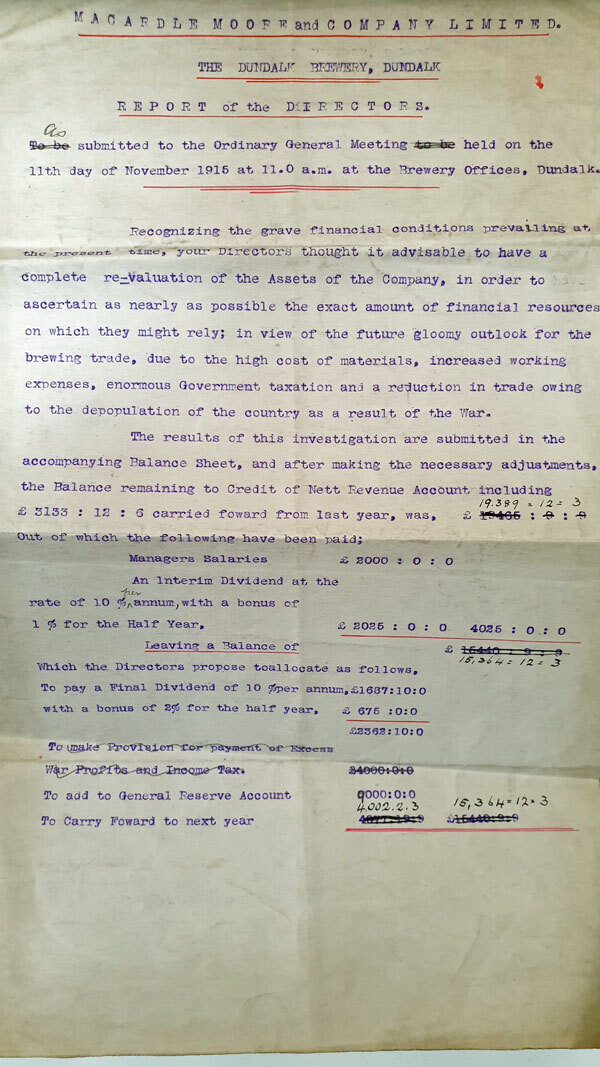
Accounts for the limited company were prepared for six-month periods ending 28 February and for 12 months ending 31 August, maintaining the same reporting dates used by the partnership. The archives do not contain a complete set of accounts for all years; consequently, this section concentrates on the year-end accounts for the early years of the 20th century. The accounts contain a directors’ report, a profit and loss account and a balance sheet. The directors’ report for 1915, shown in Figure 1, is notable for having the longest narrative section of the years reviewed.
Tables 2, 3 and 4 show the profit and loss accounts, balance sheets and financial information from the directors’ reports for 1909 (PP470/A/8/5), 1912 (PP470/A/8/7), 1914 (PP470/A/8/8) and 1915 (PP470/A/8/9).[8] These accounts show profits being made in each of the four years examined. The balance sheets are healthy and debt-free, with strong year-end cash and bank balances. Across these four years, the business is highly liquid, with an average current ratio of 10.7:1, meaning that current assets are 10.7 times the current liabilities. The average acid test ratio is 8.6:1, meaning that current assets other than stock are 8.6 times the current liabilities.[9] Dividends are paid each year, with ‘bonus’ dividends in some years. Detailed financial analysis, particularly in relation to the large increase in brewing profits in 1915, is restricted due to the lack of information disclosed about sales and cost of sales. Companies were not obliged to disclose turnover or sales figures until the enactment of the Companies (Amendment) Act 1986 (Clarke & Gardner, 2004).
The overall financial result for a year has to be traced through the profit and loss account, then the balance sheet, and finally the directors’ report. The profit and loss accounts conclude with the figures for balance to nett revenue account, which are then transferred to the capital and liabilities section of the balance sheets. There payments made for interim dividends and managers’ salaries and, in 1915, an adjustment to the reserve account, are shown to arrive at the balance for appropriation. The breakdown of intended appropriation is then shown in the directors’ reports, and includes final and ‘bonus’ dividends, provisions for depreciation and reserve items.
This treatment of final and ‘bonus’ dividends appears correct, as these items had not been paid and were not legally due for payment until approval was obtained at the annual general meetings, which could only happen after the end of the financial year. It is less clear why the provisions and reserves items could not have been reflected in the balance sheet. Some of the accounts are hand-written, while others are typed. Generally, the directors’ reports do not contain a narrative element, except for 1900 and 1915. Instead, they list nett income, managers’ salaries, dividends paid and proposed, depreciation, and movements on reserves. The accounts contain items expressed in pounds, shillings and pence, but do not contain comparative figures for the preceding period. It was not until the 1920s and 1930s when F. R. M. de Paula, influenced by American thinking, provided “perhaps for the first time in Britain”, comparative figures for the previous balance sheet, and used only pounds and omitted shillings and pence in the financial statements (Zeff, 1974, p. 33). Furthermore, as Clarke and Gardner (2004) have noted, a legal requirement for companies to provide comparative figures was only introduced in 1948 in Britain and in 1963 in Ireland.
The accounts for 1915 (PP470/A/8/9) contain some alterations made by pen, and do not contain an audit opinion, which indicates that these may not be the final version for that year.[10] For the accounts that do contain an auditor’s report, it is not addressed to any particular user, and it is unclear whether the audit opinion relates solely to the balance sheet.[11] The directors’ report for 1915, shown in Figure 1, is notable for having the longest narrative section of the years reviewed. The 1915 accounts were examined in more detail by Gibney (2018a) to reconcile the balance sheet movements between 1914 and 1915. The 1915 increase in brewing profits does not appear to be consistent with the content of the directors’ report for that year, which refers to the “grave financial conditions prevailing”, the advisability of having “a complete re-valuation of the assets” to “ascertain as nearly as possible the exact amount of financial resources on which they might rely; in view of the future gloomy outlook for the brewing trade” (PP470/A/8/9). The requirements for directors’ reports and their contents were introduced in section 158(1) of the Companies Act 1963, which specified the obligation of directors to report “on the state of the company’s affairs” (Companies Act 1963). Comparison of the 1914 (PP470/A/8/8) and 1915 (PP470/A/8/9) balance sheets indicates that the directors acted on their stated intention to revalue the assets in anticipation of an uncertain future during World War I. Comparison of the balance sheets for 1914 and 1915 shows decreases in debtors (£20,249), premises (£16,807) and investments (£3,258), and an increase in creditors (£7,941) between 1914 and 1915. Taken together, these decreases in assets and increase in a liability may be the cause for a decrease in reserves (£46,323) apparent from Table 3, being the difference between the 1914 balance of £133,323 and the 1915 balance of £87,000.
The 1915 directors’ report includes a reference to making “provision for payment of Excess War Profits and Income Tax” (PP470/A/8/5). A typewritten amount of £4,000 for excess profits duty was crossed out in ink and the amount of £4,000 was instead added to the original figure of £5,000 for addition to the general reserve account, which became £9,000 (PP470/A/8/5). This refers to the excess profits duty set out in the Finance (No. 2) Act 1915 (enacted in December 1915), whereby profits of a trade or business in excess of a pre-war standard level were to be taxed at a rate of 50%.[12] The excess profits duty has been described as “the first British or Irish corporation tax of general application” (de Cogan, 2013, p. 22).
.jpeg)
Financial Wealth of the Macardles and the Moores
As previously discussed, four key individuals associated with Macardles in the period under review were Edward Henry Macardle, his wife Margaret Macardle, their eldest son Thomas Callan Macardle, and Andrew Thomas Moore. While Thomas Macardle had other business interests (Gibney, 2018a), and it is unknown whether Edward and Margaret Macardle had additional sources of income, it is reasonable to assume that most of their wealth (as evidenced by the value of their estates at death) derived from the brewery. Andrew Moore, by contrast, had significant business interests outside the brewery (“Death of Alderman Moore, JP,” 1887). Although his capital account in the partnership eventually grew to approximately twice the value of Edward Macardle’s, it is likely that his wealth mainly derived from interests beyond the brewing business. The value of their estates, along with estimates of their equivalent value in current (2025) terms, is presented in Table 5.[13]
The accounts of the limited company show a stable dividend policy between 1909 and 1915, of paying a fixed percentage of 10% of the value of issued share capital as dividends. Payment was split each year between interim and final dividends. In addition, what was termed a ‘bonus’ dividend of 1% was paid in 1912, 1914 and 1915, while a further bonus dividend of 2% was also paid in 1915.[14] No justifications or criteria are disclosed in the accounts for payment of bonus dividends. The payment of increased dividends in 1915 does not appear to be consistent with the message of “grave financial conditions” and a “gloomy outlook for the brewing trade” mentioned in that year’s directors’ report. The stable dividend policy of a fixed 10% dividend, along with ‘bonus’ dividends, is likely to have appealed to the members of the Macardle and Moore families who were shareholders in the brewery.
In addition to dividends, other amounts paid out each year by Macardles include directors’ fees, commission on profits (approximately 6%, based on profit and loss accounts – see Table 2), and managers’ salaries. As stated above, the company’s articles of association specified that Margaret Macardle was entitled to an annual salary of £200 as managing director (PP470/A/1/1). This amount would account for most of the directors’ and auditors’ fees reported in the profit and loss account. It is also reasonable to assume that some, if not all, of the commission and managers’ salaries were paid to members of the Macardle and Moore families.
Aside from the financial flow, there is an apparent information deficit between what is disclosed in the partnership accounts, when ownership was shared between two individuals, and the limited company accounts, when board membership and ownership was shared among a larger number of individuals. It may be that this information deficit was addressed through the frequent meetings of directors and shareholders, as outlined earlier, although the absence of surviving minutes means that this cannot be confirmed from the archival records. If so, this would be consistent with the view of Clarke and Gardner (2004, p. 13) that as many Irish limited companies in the early years of the 20th century were “owned and controlled by the original owner-manager families”, with incorporation done for tax reasons, “there was little need to communicate financial information outside the firm”.
Discussion
In the absence of a published history of Macardles, a prominent and family-owned brewery based in one of Ireland’s most important brewing centres at the turn of the 20th century, this paper seeks to explore its accounting and governance practices. The analysis draws on contemporary professional guidance, namely Walkden (1891), Wilkinson (1912) and Palmer (1890).[15] Based on the limited accounting records available, Macardles appears to have followed brewery accounting practices broadly consistent with those set out by Walkden (1891), and to a lesser extent Wilkinson (1912). It seems that the guidance of Palmer (1890) was followed in the conversion of the business from a partnership to a limited liability company. Macardles’ financial year-end of 31 August was close to the 30 September date recommended by Walkden (1891), which meant that Macardles could finish their year reasonably close to the low point for holding stocks. Macardles owned public houses, as suggested by Walkden (1891), and maintained malt and brewing accounts, consistent with both Walkden (1891) and Wilkinson (1912).
More recent advice on reviewing historical accounts is provided by Amernic and Elitzur (1992) and Clarke and Gardner (2004). Amernic and Elitzur (1992, p. 37) emphasise the need to “deduce the nature of an account from the description of how it works in the annual report rather than from its location and title”, as both the location and title are different to modern financial statements; they give the treatment of depreciation as an example.[16] The accounts of Macardles as a limited company largely conform (apart from one significant difference) with what Clarke and Gardner (2004) find in their examination of the accounts for 1900 of a public company, Arnott & Company Dublin Limited (hereafter Arnotts), which operated a prominent Dublin department store. The profit and loss account of Arnotts is divided into sections, which Clarke and Gardner (2004, p. 14) call ‘above the line’ and ‘balance now available’. This results in Arnotts having a simpler profit and loss account layout than Macardles. The ‘above the line’ section contains the same categories of information as the Macardles profit and loss account, and the total is taken to the balance sheet, but the important difference is that the ‘balance now available’ section contains proposed dividends, reserve items, etc. As a result, the Arnotts profit and loss account contains the financial information similar to that found in the Macardles directors’ report, but in a way that more clearly identifies the retained profits for the year and provides a clearer link between such figures in the profit and loss accounts and the balance sheets.
During and after the transition of Macardles from a partnership to a limited company, it seems that the Macardle and Moore families were determined to retain the status of the business as a family-owned private company. This is evidenced by the restrictions in the articles of association (PP470/A/1/1), both at the formation of the company and later after the Companies Act 1907 came into force. This determination extended to putting restrictions in place for shares and for debentures. The experience of Macardles as a family-controlled business can be assessed by reference to the work of Alfred Chandler, and in particular his influential book Scale and scope: The dynamics of industrial capitalism, in which he uses the phrase “personally managed enterprises” when discussing governance and management style in businesses. (Chandler, 1994, p. 240). Chandler (1994, p. 390) concludes that the structures typically found in British family firms were influenced by the goal of providing “a steady flow of cash to owners – owners who were also managers”, which resulted in high levels of dividends, low levels of retained profits and the use of preference shares and debentures.
Chandler’s influence can also be seen in the study by Acheson et al. (2016) of the financing of breweries in the UK at the end of the 19th century and early years of the 20th century. Acheson et al. (2016, p. 726) note “the general perception […] that breweries were the typical Chandlerian firm in that they were family-controlled and thus are believed to have performed poorly”.[17] Church (1990, p. 704) comments, while discussing the work of Chandler, that the businesses of “Britain’s Victorian industrialists”, including the drinks industry, were “owner-controlled, frequently managed by founders or their families, and lacking extensive management hierarchies”. Church (1990, p. 706) also states that “by the very nature of personal enterprises after the first generation, owners tended to possess wealth, rendering income a welcome but less crucial objective”. An assessment, therefore, of Macardles as a family-controlled business in the period covered by this study, would on balance find the opposing views to Chandler to be more persuasive in terms of capital structure and policies for dividends and retained profits. The stable dividend policy of paying a constant dividend, supplemented by bonus dividends in some years, may have been attractive to shareholders, but may also have limited the company’s capacity to reinvest in the business. While the limitations of nominal share capital as a measure of the size of joint stock companies have been acknowledged, Macardles’ nominal share capital was broadly in line with the average for new companies registered in Ireland during the year Macardles converted to a limited company (1895) and was significantly greater than the average for all companies registered at the end of that year. Macardles was not financed through debentures or preference shares. It had a stable dividend policy, with dividends determined as a percentage of nominal share capital rather than of profits.
Notwithstanding the lack of board minutes available in the archives, Macardles seems to have taken its responsibilities as a limited company seriously, as evidenced by the practice of holding almost-monthly board meetings and requiring directors to sign the attendance book. The directors’ reports reviewed contain very little narrative information, making the type of analysis used by Moreno and Quinn (2020) impossible. Significant gaps in the records have been noted, most notably the absence of board minutes, which could have provided valuable insights into the company’s governance and decision-making processes.
Concluding Comments
The accounts of Macardles as a limited company reviewed in this paper cover the years immediately before the start of World War I and the early years of the war. The war undoubtedly had a significant impact, both on the business and on the Macardle family. For the business, the 1915 directors’ report shows the impact of the “complete re-valuation of the assets” due to the “future gloomy outlook for the brewing trade” arising from “the depopulation of the country as a result of the War” (PP470/A/8/9). The same report also contains a reference (albeit crossed out) to the excess profits duty introduced as a wartime measure by the British Government (PP470/A/8/9). At the same time, however, the brewery “did a very big trade in supplying ale to the British army […] and also exported to the troops in Liverpool and in the Mediterranean” (Ógra Dun Dealgan, 1986, p. 80). For the Macardle family, Thomas Callan Macardle, a director of the brewery, was awarded a knighthood in 1920, at least in part for his efforts in support of recruitment for the war effort (Gibney, 2018b).[18]
The modern climate for brewing in Ireland is largely dominated by headlines about closures of pubs (Dooley, 2025) and closures of independent breweries (Taylor et al., 2025), but there are also some grounds for optimism based on experiences in other countries (Brown, 2024; Cole, 2025). Macardles ale continues to be brewed by Diageo, albeit in Dublin rather than Dundalk, and the ongoing efforts (including a website, sale of merchandise and organisation of events) of the Macardles Historical Society are “dedicated to preserving the memory of the proud brewing tradition of […] over 140 years of brewing at Cambricville” (Macardles Historical Society, 2025). The digitisation of Macardles records and the ongoing efforts to add more records to the digital archive is a positive development, and online access may encourage further studies of the history of Macardles, thereby adding to the number of archival studies of private (as opposed to public) companies.
If Macardles had survived as a small, independent brewery in north-eastern Ireland, it may have capitalised on the brewing heritage of Dundalk, similar to craft brewers located in areas with a brewing heritage in regions of England such as Yorkshire (Tighe & Bounds, 2009). The Macardle case can be contrasted with the experience of two other breweries, namely Coopers Brewery (hereafter Coopers), an Australian brewery founded around the same time as Macardles; and Beamish & Crawford, a Cork-based brewer incorporated as a limited company in the same year (1895) as Macardles. Both Coopers and Beamish & Crawford have been the subject of official histories (Ó Drisceoil & Ó Drisceoil, 2015; Painter et al., 2013). Coopers was founded in 1862 by Thomas Cooper (1826–1897), an immigrant from England. The brewery has been owned by six generations of the Cooper family (Byrom & Lehman, 2009). Coopers has a market share of around 3% in a beer market dominated by two Japanese-owned breweries which between them have a share of around 90% of the Australian market (Byrom & Lehman, 2009). Coopers successfully defended a takeover bid by the Japanese-owned Lion Nathan in 2005 by “persuading its shareholders that the future lay in family hands as opposed to those of the multinational” (Byrom & Lehman, 2009, p. 518).[19] A small, family-owned brewery was, “to the astonishment of many observers”, able to “retain the loyalty of its shareholders” who might have been expected to “gladly accept an offer at a large premium” (Lessing & Johns, 2006, p. 24). Beamish & Crawford was established in Cork in 1792. Its Beamish stout brand is owned by Heineken, and its recent popularity in certain sectors of the beer market in Britain and Ireland has been described as the brand “having a moment” (Finn, 2026).
As outlined earlier, this study adopts a traditional accounting history approach, which is limited in that it does not go beyond the narrative of the surviving accounting records. As additional records become available, future research from a ‘new’ accounting history perspective would augment the findings here. A potential avenue for further study is to bring the Macardles story up to date through an examination of developments in the 1950s (association with Ind Coope), the 1960s (formation of Irish Ale Breweries), and the 1980s (Irish Ale Breweries taken over by Guinness), and the eventual cessation of brewing in Dundalk in 2001. A further avenue would be to compare and contrast the subsequent development of Macardles, Beamish & Crawford and Coopers.[20] There is also scope to investigate the histories of other breweries in the Dundalk area that did not survive as long as Macardles, similar O’Brien’s (2000) study of brewing in Cork.
Finally, there is scope to develop the Macardles case as a teaching case study which combines accounting history and the development of financial reporting in the 20th century. Such an endeavour could draw on the pedagogic experiences of Clarke and Gardner (2004) and Amernic and Elitzur (1992). Clarke and Gardner (2004) use one company’s financial statements from 1900 and 1999; Amernic and Elitzur (1992) use one company’s financial statements from 1924 and 1925. Such a teaching case based on Macardles could be particularly beneficial if it could use financial statements for an accounting period after the Companies Act 1963 came into force.
Acknowledgements
The assistance provided by the Louth County Archives and the Macardles Historical Society, particularly the permission granted by the society to use the material in Figure 1, is gratefully acknowledged.
With the caveat that there would be differences between employment numbers in 1923 and 1926, using the total number employed in brewing in 1926 of 4,625 (Barry, 2023, p. 38) and comparing that figure with the number 3,000 were employed in Guinness in 1923 (Barry, 2023, p. 47), indicates that the Irish brewers other than Guinness had low numbers of employees.
About €3.2 billion in 2026 values.
A more important figure is paid-up share capital. Although that figure is not broken down by sector, the total paid-up share capital of all companies registered on 31 December 1925 was £36,073,772 (“Companies Registered in the Free State,” 1926, p. 8).
The term ‘tied house’ refers to a public house that is contractually obliged to purchase at least some of its beer from a particular brewery, unlike a ‘free house’ that is free to purchase its beer from any brewery.
In later years, the two partners shared profits equally.
The total value of nominal share capital for the 90 companies registered in Ireland during 1895 was £3,774,255 (Board of Trade, 1896, p. 247) giving an average of £41,936. The total value of nominal share capital for the 895 companies registered in Ireland at the end of 1895 was £27,342,308 (Board of Trade, 1896, p. 245) giving an average of £30,550.
Margaret Macardle is believed to have been the first woman to hold the position of chairman of a brewery in Britain or Ireland.
There are small rounding differences because only amounts in pounds in the source materials have been included; shillings and pence have been ignored.
The ‘current ratio’ is calculated by dividing the figure for current assets by the figure for current liabilities, and a ratio of 2:1 is generally considered acceptable. The ‘acid test ratio’ is calculated by dividing the figure for current assets excluding stock (because stock is considered less liquid) by the figure for current liabilities, and a ratio of 1:1 is generally considered acceptable.
It is possible that the document in the archives (PP470/A/8/9) reflects the outcome of the ordinary general meeting, as some alterations are reflected in the use of the past tense. For example, “to be submitted” is changed to “as submitted”, and “to be held” is changed to “held”.
In the 1914 accounts, for example, the profit and loss account and the balance sheet are on the same page. Below the balance sheet is the audit opinion by Carter & Company, Chartered Accountants, that “The above Statement has been prepared from the books of Macardle Moore & Coy. Limited and in our opinion accurately sets forth the position of the Company on the 31st day of August 1914.” (PP470/A/8/8)
The excess profits duty was intended to apply to profits made in accounting periods ending after 4 August 1914 and before 1 July 1915 (Finance (No. 2) Act 1915). While the 1915 accounts of Macardles did not fall within this definition, de Cogan (2013) has outlined how the measure remained on the statute books for subsequent years.
Values from 1922 onwards have been converted using the Central Statistics Office CPI inflation calculator at https://visual.cso.ie/?body=entity/cpicalculator. Pre-1921 values have been converted using the Bank of England inflation calculator at https://www.bankofengland.co.uk/monetary-policy/inflation/inflation-calculator.
While ‘bonus’ dividends of 1% or 2% may appear small, they nonetheless represent 10% or 20% of the regular dividends.
While it is not suggested that Macardles followed the guidance of Walkden (1891) or Wilkinson (1912), the archival records indicate that Palmer (1890) was used.
For Macardles, understanding the treatment of depreciation involved analysing depreciation expense in the profit and loss account, the relevant assets in the balance sheet, and reserve movements in the directors’ report.
Acheson et al. (2016) confine their study to publicly quoted breweries.
Thomas Macardle also suffered personal loss during World War I, when his son Kenneth was killed at the Battle of the Somme in July 1916 (Gibney, 2018b).
Lion Nathan held third-tier pre-emptive rights to enable purchase of Coopers shares, as a legacy of a decades-long share swap in 1962 between Coopers and the South Australian Brewing Company (hereafter SA Brewing). Coopers sold its shares in SA Brewing in 1982 and SA Brewing was bought by Lion Nathan in 1993, and Cooper family members became the sole shareholders in Coopers in 1995. The takeover battle, of which the pre-emptive rights were just one element, was described as “one of the most fascinating and vigorously contested takeover battles in Australian corporate history” (Lessing & Johns, 2006, p. 4).
Archival sources for such research include the Beamish & Crawford archives, the Macardles archives (including the digital archive), and the Guinness archives.